
04 · Services
Integrations and tracking
Most companies have data. Just in five systems that disagree. We connect the e-shop, CRM, ad accounts and analytics so there is one definition of an order and one number you can trust.
We build integrations through official APIs with OAuth, never by storing third-party passwords. Every transfer is idempotent, so a network outage never creates a duplicate order or a second e-mail. We set up tracking to match the books: GA4 and server-side GTM, Consent Mode v2 set before any other tag, conversions for Google, Meta and Sklik verified against real orders. We generate product feeds per market and comparison engine, with error checks before sending. Where no ready-made connector exists, we write one: for Shoptet, Shopify, SmartEmailing, Heureka, Google Merchant or your internal system.
- Map of systems and data: what originates where and where it should flow
- One definition of metrics and of an order
- Connectors via API with OAuth and idempotence
- GA4, sGTM, Consent Mode v2, conversions for ad accounts
- Verification against real orders and documentation
- Connectors in a repository that is yours
- Tracking verified against orders
- Feeds for Merchant, Heureka, Zboží.cz and others
- Documentation of data flows
- Alerts when something disconnects
What people ask most
Why do orders in GA4 not match the e-shop?
Most often because of consent (without it, tracking does not fire), duplicate or missing events, and a different definition of an order (cancellations, returns, VAT). Server-side tracking and Consent Mode v2 close part of the gap; the rest needs one definition and a check against the e-shop. That is exactly what we set up.
Is server-side tracking a way around consent?
No. The server must respect consent too. Server-side tracking improves control over data, resilience against blockers and site speed, but it must never measure what a visitor declined. That is why our cookie banner sets Consent Mode v2 before any tag fires.
Can you connect to our internal system without an API?
Usually yes. We can read exports, databases and e-mails and turn them into an API the rest of the integration uses. It is slower and more fragile than an official interface, so we always say so up front.
Related projects
Products we run every day

Our own cookie banner with Consent Mode v2
A banner that sets Consent Mode v2 before any other tag, proves consent and deploys on any site with no licences.

Safe Logic website: from a builder to Next.js
A window and door service website ported from the Sitejet builder to Next.js 15, with forms wired to MySQL, Raynet CRM and e-mail, its own admin and per-page SEO.
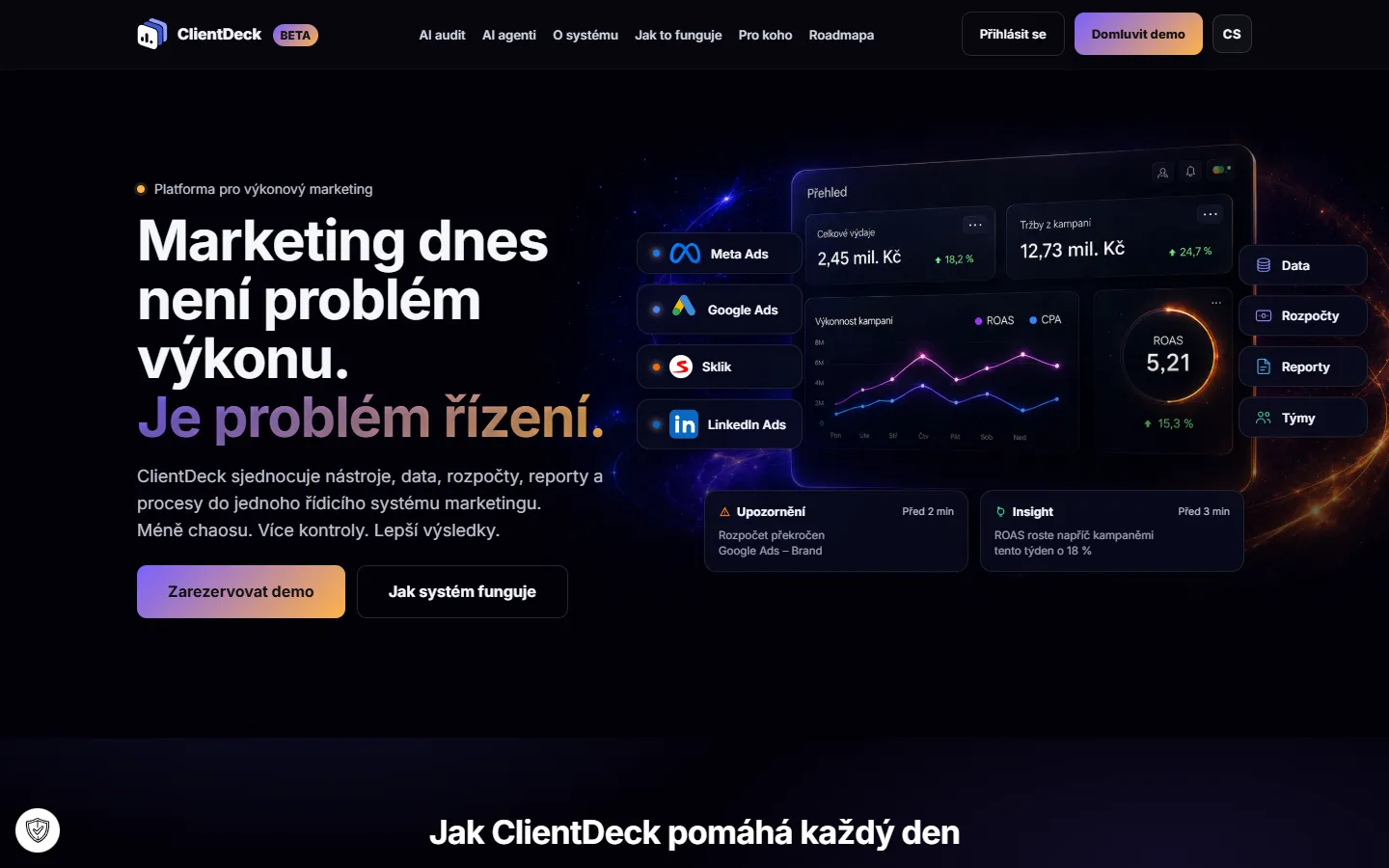
ClientDeck: a campaign control system
Our own SaaS that brings Google Ads, Meta, Sklik and comparison engines into one control system with alerts and an approval queue.
Other services
Next.js websites that are fast, readable for search engines and AI, and ready for campaigns from day one.
More about this service →02Automation and AIWe turn processes done by hand today into code. Language models where they read and propose, people where decisions are made.
More about this service →03Applications and internal toolsCustom systems where off-the-shelf software falls short: control panels, admin interfaces, tablet apps, SaaS.
More about this service →05Hosting and operationsGit deploys with health checks and automatic rollback. Updates, backups, monitoring. On our panel or on your infrastructure.
More about this service →Contact
Have a project? Write to us.
A few sentences about what you are dealing with is enough. We reply within one working day with questions and a proposed approach.